


[May 20, 2026] Huawei H13-511_V5.5 Exam Dumps Are Essential To Get Good Marks
Latest Huawei H13-511_V5.5 Dumps with Test Engine and PDF (New Questions)
Huawei H13-511_V5.5 Exam Syllabus Topics:
| Topic | Details |
|---|---|
| Topic 1 |
|
| Topic 2 |
|
| Topic 3 |
|
| Topic 4 |
|
| Topic 5 |
|
| Topic 6 |
|
| Topic 7 |
|
NEW QUESTION # 69
In Huawei Fusion Computer, when the virtual machine is in the "running" or "stopped" state, the user can increase or decrease the number of vCPUs of the virtual machine
- A. False
- B. True
Answer: A
NEW QUESTION # 70
A switch can learn the source and destination MAC addresses of traffic and add the addresses to a MAC address table. It cannot isolate collision domains.
- A. FALSE
- B. TRUE
Answer: A
Explanation:
In the HCIA-Cloud Computing curriculum, Ethernet switches are core components of the data center network and operate mainly at thedata link layer. One of their key functions isMAC address learning. When a switch receives a frame, it records thesource MAC addressand the corresponding incoming port in the MAC address table. This allows the switch to forward subsequent frames intelligently.
More importantly, a switchcan isolate collision domains, which makes the statement false. Each switch port represents anindependent collision domain, meaning that collisions occurring on one port do not affect other ports. This is a major improvement over hubs, which place all connected devices in a single collision domain.
However, switchesdo not isolate broadcast domainsby default. Broadcast traffic is forwarded to all ports within the same VLAN. Broadcast domain isolation requires technologies such asVLANs or routers.
Since the statement claims that a switchcannotisolate collision domains, which contradicts the HCIA definition of switching behavior, the correct answer isFALSE.
NEW QUESTION # 71
Enterprise administrators provision virtual desktops and perform routine maintenance through virtual desktop service management. Which of the following are the provisioning proportion modes of preset virtual desktops in desktop provisioning management?
- A. M:N
- B. 1+1
- C. 1:1
- D. 1:N
Answer: C,D
Explanation:
In the Huawei FusionAccess solution, desktop provisioning is the process of creating and assigning virtual machines to users. The "provisioning proportion mode" is a key parameter in this process. Mode A (1:1) represents the "Single User" or "Static" assignment mode. In this configuration, one virtual machine is permanently bound to one user. This is typically used for Full Copy desktops where the user requires a persistent environment with their own dedicated storage and personalized settings. The user has exclusive rights to the VM, and their data remains on the disk even after logging off. This ensures the highest level of personalization and performance for individual employees.
Mode B (1:N) represents the "Dynamic" or "Pool" assignment mode. In a 1:N scenario, a group of users shares a pool of virtual machines. This is commonly implemented using Linked Clone technology to save storage space and simplify management. For example, in a task-oriented environment like a call center or a training center, multiple users (N) can log into a set of virtual machines based on the same template (1) at different times. The system assigns an available VM from the pool to the user upon login. This maximizes resource utilization because not all users are online simultaneously.
Furthermore, the selection of these modes directly affects the backend storage design and the maintenance strategy. For 1:1 desktops, backup and disaster recovery must be managed per individual VM, whereas for 1:
N pooled desktops, the administrator focuses on the security and integrity of the "Golden Image" or parent template. Understanding these two primary modes is crucial for administrators to choose the right technology-Full Copy for persistent 1:1 needs or Linked Clone for efficient 1:N pools-based on user requirements and hardware capacity.
NEW QUESTION # 72
Mai, a technician from an enterprise, added storage to the fusion computer, and the NAS storage was successfully added, but failed when adding FC SAN as a storage resource. The reason may be that the configuration of the storage interface is wrong.
- A. False
- B. True
Answer: B
NEW QUESTION # 73
Which of the following statements about the differences between user groups and organizational units (OUs) are true?
- A. A user group can only contain accounts.
- B. An OU can contain objects such as accounts, computers, printers, and shared folders.
- C. OUs and user groups are Active Directory objects.
- D. Group policies can be configured for both OUs and user groups.
Answer: B,C
Explanation:
Comprehensive and Detailed Explanation (HCIA-Cloud Computing aligned):
In AD, OUs and user groups are both used for organizing and managing resources, but they differ in function.
* A is true. Both OUs and user groups are AD objects.
* B is true. An OU can contain multiple types of AD objects, including users, computers, printers, and shared resources.
* C is false. Group policies cannot be directly applied to user groups; they are applied to domains, sites, or OUs.
* D is false. A user group can contain users, computers, and even other groups, not only user accounts.
Thus, the correct answers are A and B.
NEW QUESTION # 74
The () function in the fusion compute cluster feature can help enterprises achieve green energy saving. For example, during the business peak period, business virtual machines can be migrated to some physical hosts in a centralized manner, and then other physical hosts can be powered off.
Answer:
Explanation:
DPM
NEW QUESTION # 75
Which of the following statements arefalseabout VLAN technology?
- A. A hybrid interface cannot be used to connect a switch and a server.
- B. A trunk link allows untagged packets from multiple VLANs to pass through.
- C. An access interface is used to connect switches.
- D. A trunk interface is used to connect switches.
Answer: A,B,C
Explanation:
VLAN technology is a fundamental topic in HCIA-Cloud Computing, especially for cloud network isolation and segmentation.
OptionAis false. Atrunk linkis designed to carry traffic frommultiple VLANs using VLAN tags (802.1Q).
Untagged traffic typically belongs to anative VLAN, not multiple VLANs.
OptionBis false. Ahybrid interfacecanbe used to connect a switch to a server. Hybrid interfaces support both tagged and untagged VLAN traffic and are commonly used in server and virtualization scenarios.
OptionCis true.Trunk interfacesare primarily used to connectswitch-to-switchlinks, allowing multiple VLANs to pass between switches.
OptionDis false.Access interfacesare designed to connectend devices(such as PCs or printers) and carry traffic foronly one VLAN, not for switch interconnections.
Therefore, the false statements areA, B, and D.
NEW QUESTION # 76
Which of the following are computing algorithms in the evolution of computer science? (Multiple choice)
- A. Function Compute
- B. Distributed Computing
- C. Parallel Computing
- D. Grid Computing
Answer: B,C,D
NEW QUESTION # 77
Which of the following descriptions about centralized storage and distributed storage is wrong?
- A. Distributed storage system is to disperse and store data on multiple independent devices. When reading data, it needs to read data on multiple devices at the same time, so it will affect the rate of data reading
- B. The distributed network storage system adopts a scalable system structure and uses multiple storage servers to share the storage load. It not only improves the reliability, availability and access efficiency of the system, but is also easy to expand
- C. The biggest feature of centralized storage is that the deployment structure is simple, and RAID technology can also be used to ensure data security and reliability
- D. Centralized storage can be divided into SANFINAS storage according to the technical architecture, and SAN storage can be divided into FC-SAN and IP-SAN
Answer: A
NEW QUESTION # 78
TAP is a virtual network device independently maintained in Linux.
- A. TRUE
- B. FALSE
Answer: A
Explanation:
Comprehensive and Detailed Explanation (HCIA-Cloud Computing aligned):
In Linux-based virtualization environments, a TAP device is a software-based virtual network interface that operates at Layer 2 of the OSI model.
TAP devices are independently maintained by the Linux kernel and are commonly used to connect virtual machines to virtual switches or bridges. They simulate physical Ethernet interfaces, allowing VMs to send and receive Ethernet frames.
This definition aligns with HCIA-Cloud Computing networking fundamentals, so the statement is TRUE.
NEW QUESTION # 79
A VLAN belongs to a broadcast domain, and hosts in a VLAN can communicate with each other, but hosts between VLANs cannot directly access each other.
- A. False
- B. True
Answer: B
NEW QUESTION # 80
A company has deployed its business on the FusionCompute platform. In order to optimize the memory access performance of the virtual machine, which of the following virtual machine features should be used?
- A. Template deployment
- B. Snapshot
- C. NUMA
- D. Resource hot addition
Answer: C
NEW QUESTION # 81
A bare VM is required when creating a virtual desktop template on FusionAccess. Which of the following statements aretrueabout creating a bare VM?
- A. TheConfiguration Modeof the system disk must be set toThin provisioning.
- B. NICs cannot be added when creating a linked-clone bare VM, but NICs can be added when the linked- clone template is used for quick provisioning.
- C. TheConfiguration Modeof the system disk must be set toCommon.
- D. The NIC can be the service-plane distributed virtual switch (DVS) and port group of the user VM.
Answer: B,C
Explanation:
Bare VM creation rules in FusionAccess are strict to ensuretemplate consistency and successful provisioning:
* Ais true: The system disk must useCommon configuration mode, not thin provisioning.
* Bis true: For linked-clone bare VMs, NICs are addedafter template creation, during desktop provisioning.
* Cis false: Bare VMs should usemanagement-plane networking, not user service-plane DVS/port groups.
* Dis false: Thin provisioning isnot allowedfor the system disk of a bare VM.
Therefore, the correct answers areA and B.
NEW QUESTION # 82
When the amount of memory in a computing node is fixed, enabling memory multiplexing can increase the virtual machine density of the computing node.
- A. False
- B. True
Answer: B
NEW QUESTION # 83
Match the following VLAN interface types with their descriptions.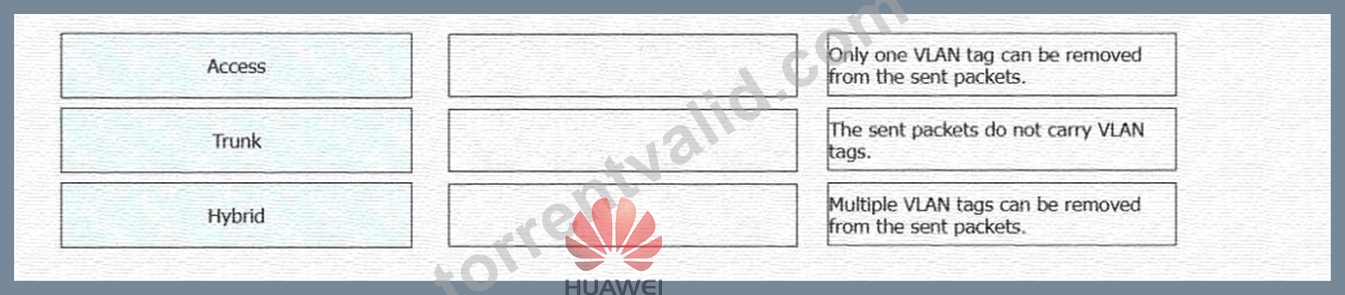
Answer:
Explanation: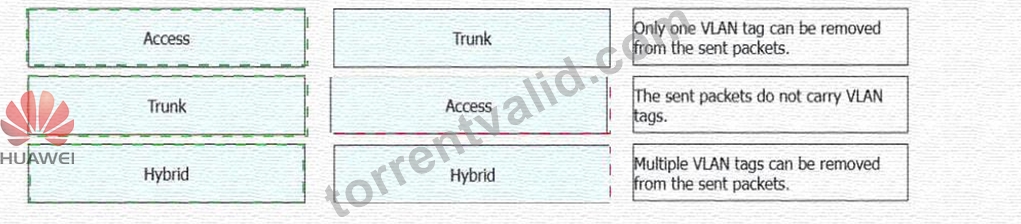
Explanation:
Access Interface
#The sent packets do not carry VLAN tags.
An access interface belongs to only one VLAN.
Frames are sent untagged, making it suitable for end devices such as PCs and printers.
Trunk Interface
#Only one VLAN tag can be removed from the sent packets.
A trunk interface allows multiple VLANs to pass.
Typically used for switch-to-switch connections.
Only the native VLAN is sent untagged; other VLANs are tagged.
Hybrid Interface
#Multiple VLAN tags can be removed from the sent packets.
A hybrid interface supports both tagged and untagged VLAN traffic.
Multiple VLANs can be configured to send traffic without VLAN tags.
Commonly used for server connections and virtualization environments.
NEW QUESTION # 84
Through VIMS, FusionCompute manages virtual machine images and configuration files in the form of files.
- A. False
- B. True
Answer: B
NEW QUESTION # 85
Set NUMA in Fusion Computer to improve the memory access performance of the virtual machine. Which of the following descriptions about setting NUMA architecture settings is correct?
(Multiple choice)
- A. After the virtual machine NUMA architecture automatic adjustment is enabled, the system will automatically calculate the virtual machine NUMA architecture topology information based on the virtual machine configuration, physical host NUMA configuration and other information
- B. If the virtual machine NUMA architecture adjustment method needs to be manually adjusted, the virtual machine should be bound to the host
- C. If the virtual machine NUMA architecture adjustment method needs to be set to automatic adjustment, the virtual machine should be bound to the host
- D. When the virtual machine enables NUMA architecture adjustment, the adjustment method is subject to its own settings
Answer: A,B
NEW QUESTION # 86
The essence of the Internet of Things is still the Internet. Only when hardware or products are connected to the Internet and data interaction occurs, it can be called the Internet of Things.
- A. False
- B. True
Answer: B
NEW QUESTION # 87
Which of the following parameters are mandatory for quickly provisioning desktops on FusionAccess?
- A. Host
- B. Template
- C. Computer Type
- D. Security Group
Answer: A,B,C
Explanation:
In the official Huawei FusionAccess documentation, "Quick Provisioning" is a streamlined workflow designed to deploy multiple virtual desktops efficiently.1 For this process to succeed, several mandatory parameters must be defined to ensure the Virtual Machines (VMs) are created with the correct hardware and software specifications.
First, theComputer Type (A)is mandatory as it determines whether the desktops will be "Full Copy" (independent disks) or "Linked Clone" (shared base disk). This choice significantly impacts storage consumption and future maintenance. Second, aTemplate (D)is required because it serves as the "Golden Image" containing the pre-installed Operating System, drivers, and the Huawei Access Agent (HDA).
Without a template, the system cannot instantiate the VM's disk content. Third, a targetHost (B)or resource cluster must be selected to provide the physical CPU and memory resources required for the VMs to run.
WhileSecurity Groups (C)are an important part of the network configuration, they are typically associated with a "Desktop Group" rather than being a mandatory field in the quick provisioning wizard itself. If no specific security group is selected, the system often applies a default policy. According to the HCIA curriculum, the core "Provisioning Plan" focuses on the source (Template), the deployment mode (Computer Type), and the destination (Host/Cluster). Ensuring these three parameters are correctly matched is vital for the automated provisioning engine to calculate resource availability and successfully trigger the VM creation on the backend FusionCompute platform.
NEW QUESTION # 88
In FusionCompute, the security auditor in role-based access control (RBAC) mode is only permitted to view and export logs.
- A. TRUE
- B. FALSE
Answer: A
Explanation:
Huawei FusionCompute implementsrole-based access control (RBAC)to ensure secure and compliant system management.
Thesecurity auditor roleis designed specifically for compliance and auditing purposes. According to HCIA- Cloud Computing materials, this role hasread-only permissions, allowing the user toview and export system logsbut not modify configurations or perform operational tasks.
This restriction helps ensure the integrity of audit records and prevents unauthorized system changes.
Therefore, the statement isTRUE.
NEW QUESTION # 89
......
TorrentValid just published the Huawei H13-511_V5.5 exam dumps!: https://passleader.torrentvalid.com/H13-511_V5.5-valid-braindumps-torrent.html