


[2024] Free DP-420 Exam Dumps to Pass Exam Easily
DP-420 Exam Dumps, DP-420 Practice Test Questions
What are the objectives of the Microsoft DP-420 Certification Exam?
As per the guidance of the DP-420 Dumps, there are 02 main objectives of the Microsoft DP-420 Certification Exam. The first is to understand Azure Cosmos DB architecture & components, and the second is to understand the design and implementation of cloud-native applications using Microsoft Azure Cosmos DB. Assessment of the candidate's technical knowledge and skills in the field of Azure SQL Database Administration.
NEW QUESTION # 66
You have a database in an Azure Cosmos DB for NoSQL account that is configured for multi-region writes.
You need to use the Azure Cosmos DB SDK to implement the conflict resolution policy for a container. The solution must ensure that any conflict sent to the conflict feed.
Solution: You set ConfilictResolutionMode to Custom. You Set ResolutionProcedures to a custom stored procedure. You configure the custom stored procedure to use the conflictingItems parameter to resolve conflict.
Does this meet the goal?
- A. Yes
- B. No
Answer: A
Explanation:
Setting ConflictResolutionMode to Custom and configuring a custom stored procedure with the "conflictingItems" parameter will allow you to implement a custom conflict resolution policy. This will ensure that any conflicts are sent to the conflict feed for resolution.
NEW QUESTION # 67
You configure multi-region writes for account1.
You need to ensure that App1 supports the new configuration for account1. The solution must meet the business requirements and the product catalog requirements.
What should you do?
- A. Modify the connection policy of App1.
- B. Create a private endpoint connection.
- C. Set the default consistency level of accountl to bounded staleness.
- D. Increase the number of request units per second (RU/s) allocated to the con-product and con-productVendor containers.
Answer: D
Explanation:
App1 queries the con-product and con-productVendor containers.
Note: Request unit is a performance currency abstracting the system resources such as CPU, IOPS, and memory that are required to perform the database operations supported by Azure Cosmos DB.
Scenario:
Develop an app named App1 that will run from all locations and query the data in account1.
Once multi-region writes are configured, maximize the performance of App1 queries against the data in account1.
Whenever there are multiple solutions for a requirement, select the solution that provides the best performance, as long as there are no additional costs associated.
Reference:
https://docs.microsoft.com/en-us/azure/cosmos-db/consistency-levels
NEW QUESTION # 68
You have an Azure Cosmos DB Core (SQL) API account used by an application named App1.
You open the Insights pane for the account and see the following chart.
Use the drop-down menus to select the answer choice that answers each question based on the information presented in the graphic.
NOTE: Each correct selection is worth one point.
Answer:
Explanation:
NEW QUESTION # 69
You have an application that queries an Azure Cosmos 06 for NoSQL account.
You discover that the following two queries run frequently,
You need to minimize the request units (RUs) consumed by reads and writes. What should you create?
- A. a composite index for (name ASC, time stamp ASC)
- B. a composite index for (name DESC, time stamp ASC)
- C. a composite index for (name ASC, time stamp DESC)
- D. a composite index for (name ASC time stamp ASC) and a composite index for (name, time stamp disc)
Answer: A
NEW QUESTION # 70
You have a database named db1 in an Azure Cosmos DB for NoSQL
You are designing an application that will use dbl.
In db1, you are creating a new container named coll1 that will store in coll1.
The following is a sample of a document that will be stored in coll1.
The application will have the following characteristics:
* New orders will be created frequently by different customers.
* Customers will often view their past order history.
You need to select the partition key value for coll1 to support the application. The solution must minimize costs.
To what should you set the partition key?
- A. orderDate
- B. customerId
- C. orderId
- D. id
Answer: B
Explanation:
Explanation
Based on the characteristics of the application and the provided document structure, the most suitable partition key value for coll1 in the given scenario would be the customerId, Option B.
The application frequently creates new orders by different customers and customers often view their past order history. Using customerId as the partition key would ensure that all orders associated with a particular customer are stored in the same partition. This enables efficient querying of past order history for a specific customer and reduces cross-partition queries, resulting in lower costs and improved performance.
a partition key is a JSON property (or path) within your documents that is used by Azure Cosmos DB to distribute data among multiple partitions . A partition key should have a high cardinality, which means it should have many distinct values, such as hundreds or thousands . A partition key should also align with the most common query patterns of your application, so that you can efficiently retrieve data by using the partition key value1.
Based on these criteria, one possible partition key that you could use for coll1 is B. customerId.
This partition key has the following advantages:
It has a high cardinality, as each customer will have a unique ID
It aligns with the query patterns of the application, as customers will often view their past order history3.
It minimizes costs, as it reduces the number of cross-partition queries and optimizes the storage and throughput utilization1.
This partition key also has some limitations, such as:
It may not be optimal for scenarios where orders need to be queried independently from customers or aggregated by date or other criteria It may result in hot partitions or throttling if some customers create orders more frequently than others or have more data than others It may not support transactions across multiple customers, as transactions are scoped to a single logical partition2.
Depending on your specific use case and requirements, you may need to adjust this partition key or choose a different one. For example, you could use a synthetic partition key that concatenates multiple properties of an item2, or you could use a partition key with a random or pre-calculated suffix to distribute the workload more evenly2.
NEW QUESTION # 71
The settings for a container in an Azure Cosmos DB Core (SQL) API account are configured as shown in the following exhibit.
Which statement describes the configuration of the container?
- A. Items stored in the collection will expire only if the item has a time to live value.
- B. Items stored in the collection will be retained always, regardless of the items time to live value.
- C. All items will be deleted after one year.
- D. All items will be deleted after one hour.
Answer: A
Explanation:
Explanation
When DefaultTimeToLive is -1 then your Time to Live setting is On (No default) Time to Live on a container, if present and the value is set to "-1", it is equal to infinity, and items don't expire by default.
Time to Live on an item:
This Property is applicable only if DefaultTimeToLive is present and it is not set to null for the parent container.
If present, it overrides the DefaultTimeToLive value of the parent container.
Reference: https://docs.microsoft.com/en-us/azure/cosmos-db/sql/time-to-live
NEW QUESTION # 72
You have an Azure Cosmos DB for NoSQL account that frequently receives the same three queries.
You need to configure indexing to minimize RUs consumed by the queries.
Which type of index should you use for each query? To answer, select the appropriate options in the answer area.
NOTE: Each correct selection is worth one point.
Answer:
Explanation:
NEW QUESTION # 73
You have an app that stores data in an Azure Cosmos DB Core (SQL) API account The app performs queries that return large result sets.
You need to return a complete result set to the app by using pagination. Each page of results must return 80 items.
Which three actions should you perform in sequence? To answer, move the appropriate actions from the list of actions to the answer area and arrange them in the correct order.
Answer:
Explanation:
Explanation
Step 1: Configure the MaxItemCount in QueryRequestOptions
You can specify the maximum number of items returned by a query by setting the MaxItemCount. The MaxItemCount is specified per request and tells the query engine to return that number of items or fewer.
Box 2: Run the query and provide a continuation token
In the .NET SDK and Java SDK you can optionally use continuation tokens as a bookmark for your query's progress. Azure Cosmos DB query executions are stateless at the server side and can be resumed at any time using the continuation token.
If the query returns a continuation token, then there are additional query results.
Step 3: Append the results to a variable
Reference: https://docs.microsoft.com/en-us/azure/cosmos-db/sql/sql-query-pagination
NEW QUESTION # 74
You have a multi-region Azure Cosmos DB account named account1 that has a default consistency level of strong.
You have an app named App1 that is configured to request a consistency level of session.
How will the read and write operations of App1 be handled? To answer, select the appropriate options in the answer area.
NOTE: Each correct selection is worth one point.
Answer:
Explanation:
NEW QUESTION # 75
You configure a backup for an Azure Cosmos DB for NoSQL account as shown in the following exhibit.
Use the drop-down menus to select the answer choice that completes each statement based on the information presented in the graphic.
NOTE: Each correct selection is worth one point.
Answer:
Explanation: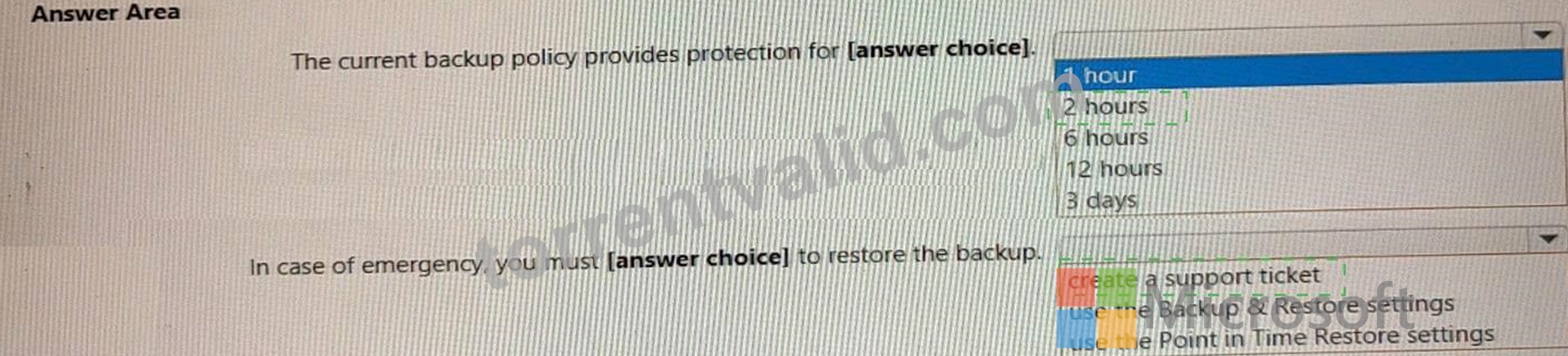
Explanation
Box 1 = The current backup policy provides protection for: 2 Hours Azure Cosmos DB automatically takes backups of your data at regular intervals. The backup interval and the retention period can be configured from the Azure portal. You can also choose between two backup modes: periodic backup mode and continuous backup mode. Periodic backup mode is the default mode for all existing accounts and it takes a full backup of your database every 4 hours by default. Continuous backup mode is a new mode that allows you to restore to any point of time within either 7 or 30 days1.
For your scenario, based on the exhibit, you have configured a backup for an Azure Cosmos DB for NoSQL account using the periodic backup mode with a backup interval of 1 hour and a retention period of 2 hours.
This means that Azure Cosmos DB will take a full backup of your database every hour and keep only the latest two backups. Therefore, the current backup policy provides protection for 2 hours.
Box 2: In case of emergency, you must (answer choice) to restore the backup = create a support ticket Azure Cosmos DB automatically takes backups of your data at regular intervals. You can configure the backup interval and the retention period from the Azure portal. You can also choose between two backup modes:
periodic backup mode and continuous backup mode. Periodic backup mode is the default mode for all existing accounts and it takes a full backup of your database every 4 hours by default. Continuous backup mode is a new mode that allows you to restore to any point of time within either 7 or 30 days1.
For your scenario, based on the exhibit, you have configured a backup for an Azure Cosmos DB for NoSQL account using the periodic backup mode with a backup interval of 1 hour and a retention period of 2 hours.
This means that Azure Cosmos DB will take a full backup of your database every hour and keep only the latest two backups. In case of emergency, you must create a support ticket to restore the backup. This is the answer to your question.
To restore data from a periodic backup, you need to create a support request with Azure Cosmos DB team and provide the following information:
* The name of your Azure Cosmos DB account
* The name of the database or container that you want to restore
* The date and time (in UTC) that you want to restore from
* The name of the target Azure Cosmos DB account where you want to restore the data
* The name of the target resource group where you want to restore the data The Azure Cosmos DB team will then initiate the restore process and notify you when it is completed2.
NEW QUESTION # 76
You plan to create an Azure Cosmos DB container named account that will contain items in the following format.
You need to define a query that will return the ids of all accounts that have ever recorded a negative value for balance.
How should you complete the query? To answer, select the appropriate options in the answer are a.
NOTE: Each correct selection is worth one point.
Answer:
Explanation:
NEW QUESTION # 77
You have three containers in an Azure Cosmos DB Core (SQL) API account as shown in the following table.
You have the following Azure functions:
A function named Fn1 that reads the change feed of cn1
A function named Fn2 that reads the change feed of cn2
A function named Fn3 that reads the change feed of cn3
You perform the following actions:
Delete an item named item1 from cn1.
Update an item named item2 in cn2.
For an item named item3 in cn3, update the item time to live to 3,600 seconds.
For each of the following statements, select Yes if the statement is true. Otherwise, select No.
NOTE: Each correct selection is worth one point.
Answer:
Explanation:
Reference:
https://docs.microsoft.com/en-us/azure/cosmos-db/sql/change-feed-design-patterns
https://docs.microsoft.com/en-us/azure/cosmos-db/change-feed
NEW QUESTION # 78
You have an Azure Cosmos DB Core (SQL) API account named account1 that has the disableKeyBasedMetadataWriteAccess property enabled.
You are developing an app named App1 that will be used by a user named DevUser1 to create containers in account1. DevUser1 has a non-privileged user account in the Azure Active Directory (Azure AD) tenant.
You need to ensure that DevUser1 can use App1 to create containers in account1.
What should you do? To answer, select the appropriate options in the answer area.
NOTE: Each correct selection is worth one point.
Answer:
Explanation:
Reference:
https://docs.microsoft.com/en-us/azure/cosmos-db/secure-access-to-data
https://docs.microsoft.com/en-us/rest/api/resources/
NEW QUESTION # 79
You need to provide a solution for the Azure Functions notifications following updates to con-product. The solution must meet the business requirements and the product catalog requirements.
Which two actions should you perform? Each correct answer presents part of the solution.
NOTE: Each correct selection is worth one point.
- A. Configure the trigger for each function to use the same leaseCollectionPrefix
- B. Configure the trigger for each function to use a different leaseCollectionPrefix
- C. Configure the trigger for each function to use the same leaseCollectionNair.e
- D. Configure the trigger for each function to use a different leaseCollectionName
Answer: B,C
Explanation:
leaseCollectionPrefix: when set, the value is added as a prefix to the leases created in the Lease collection for this Function. Using a prefix allows two separate Azure Functions to share the same Lease collection by using different prefixes.
Scenario: Use Azure Functions to send notifications about product updates to different recipients.
Trigger the execution of two Azure functions following every update to any document in the con-product container.
Reference:
https://docs.microsoft.com/en-us/azure/azure-functions/functions-bindings-cosmosdb-v2-trigger
NEW QUESTION # 80
You have an Azure Cosmos DB Core (SQL) API account.
You run the following query against a container in the account.
SELECT
IS_NUMBER("1234") AS A,
IS_NUMBER(1234) AS B,
IS_NUMBER({prop: 1234}) AS C
What is the output of the query?
- A. [{"A": true, "B": false, "C": true}]
- B. [{"A": false, "B": true, "C": false}]
- C. [{"A": true, "B": true, "C": true}]
- D. [{"A": true, "B": true, "C": false}]
Answer: B
Explanation:
IS_NUMBER returns a Boolean value indicating if the type of the specified expression is a number.
"1234" is a string, not a number.
Reference: https://docs.microsoft.com/en-us/azure/cosmos-db/sql/sql-query-is-number
NEW QUESTION # 81
You have an Azure Cosmos DB account named account1 that has a default consistency level of session.
You have an app named App1.
You need to ensure that the read operations of App1 can request either bounded staleness or consistent prefix consistency.
What should you modify for each consistency level? To answer, select the appropriate options in the answer area.
NOTE: Each correct selection is worth one point.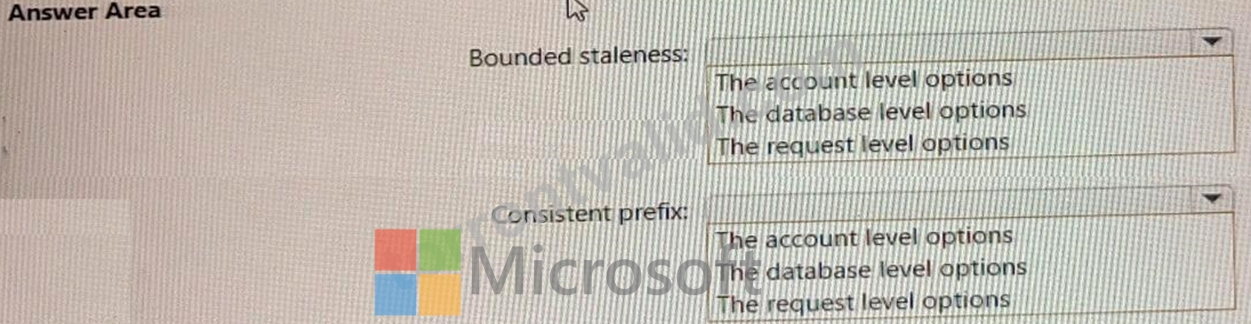
Answer:
Explanation:
Explanation:
Box 1 = The request level options
Azure Cosmos DB offers five well-defined consistency levels: strong, bounded staleness, session, consistent prefix and eventual. You can configure the default consistency level on your Azure Cosmos DB account at any time2. The default consistency level applies to all databases and containers under that account1. You can also override the default consistency level for a specific request by using the request options2.
Box 2 = The request level options
To modify the consistency level of a read operation in Azure Cosmos DB, you can use request-level options to override the account's default consistency setting. Therefore, to ensure that the read operations of App1 can request either consistent prefix or session consistency, you need to modify the request-level options for each operation. Reference: - https://docs.microsoft.com/en-us/azure/cosmos-db/consistency-levels
NEW QUESTION # 82
You have a database named db1 in an Azure Cosmos DB f You have a third-party application that is exposed thro You need to migrate data from the application to a What should you use?
- A. Azure Migrate
- B. Database Migration Assistant
- C. Azure Data Factory
Answer: C
Explanation:
you can migrate data from various data sources to Azure Cosmos DB using different tools and methods. The choice of the migration tool depends on factors such as the data source, the Azure Cosmos DB API, the size of data, and the expected migration duration1. Some of the common migration tools are:
Azure Cosmos DB Data Migration tool: This is an open source tool that can import data to Azure Cosmos DB from sources such as JSON files, MongoDB, SQL Server, CSV files, and Azure Cosmos DB collections. This tool supports the SQL API and the Table API of Azure Cosmos DB2.
Azure Data Factory: This is a cloud-based data integration service that can copy data from various sources to Azure Cosmos DB using connectors. This tool supports the SQL API, MongoDB API, Cassandra API, Gremlin API, and Table API of Azure Cosmos DB3.
Azure Cosmos DB live data migrator: This is a command-line tool that can migrate data from one Azure Cosmos DB container to another container within the same or different account. This tool supports live migration with minimal downtime and works with any Azure Cosmos DB API4.
For your scenario, if you want to migrate data from a third-party application that is exposed through an OData endpoint to a container in Azure Cosmos DB for NoSQL, you should use Azure Data Factory. Azure Data Factory has an OData connector that can read data from an OData source and write it to an Azure Cosmos DB sink using the SQL API5. You can create a copy activity in Azure Data Factory that specifies the OData source and the Azure Cosmos DB sink, and run it on demand or on a schedule.
NEW QUESTION # 83
You are developing an application that will use an Azure Cosmos DB Core (SQL) API account as a data source.
You need to create a report that displays the top five most ordered fruits as shown in the following table.
A collection that contains aggregated data already exists. The following is a sample document:
{
"name": "apple",
"type": ["fruit", "exotic"],
"orders": 10000
}
Which two queries can you use to retrieve data for the report? Each correct answer presents a complete solution.
NOTE: Each correct selection is worth one point.
A)
B)
C)
D)
- A. Option C
- B. Option B
- C. Option D
- D. Option A
Answer: B,C
Explanation:
Explanation
ARRAY_CONTAINS returns a Boolean indicating whether the array contains the specified value. You can check for a partial or full match of an object by using a boolean expression within the command.
Reference: https://docs.microsoft.com/en-us/azure/cosmos-db/sql/sql-query-array-contains
NEW QUESTION # 84
You are implementing an Azure Data Factory data flow that will use an Azure Cosmos DB (SQL API) sink to write a dataset. The data flow will use 2,000 Apache Spark partitions.
You need to ensure that the ingestion from each Spark partition is balanced to optimize throughput.
Which sink setting should you configure?
- A. Batch size
- B. Collection action
- C. Write throughput budget
- D. Throughput
Answer: A
Explanation:
Batch size: An integer that represents how many objects are being written to Cosmos DB collection in each batch. Usually, starting with the default batch size is sufficient. To further tune this value, note:
Cosmos DB limits single request's size to 2MB. The formula is "Request Size = Single Document Size * Batch Size". If you hit error saying "Request size is too large", reduce the batch size value.
The larger the batch size, the better throughput the service can achieve, while make sure you allocate enough RUs to empower your workload.
Incorrect Answers:
A: Throughput: Set an optional value for the number of RUs you'd like to apply to your CosmosDB collection for each execution of this data flow. Minimum is 400.
B: Write throughput budget: An integer that represents the RUs you want to allocate for this Data Flow write operation, out of the total throughput allocated to the collection.
D: Collection action: Determines whether to recreate the destination collection prior to writing.
None: No action will be done to the collection.
Recreate: The collection will get dropped and recreated
NEW QUESTION # 85
You have a database named telemetry in an Azure Cosmos DB Core (SQL) API account that stores IoT dat a. The database contains two containers named readings and devices.
Documents in readings have the following structure.
id
deviceid
timestamp
ownerid
measures (array)
- type
- value
- metricid
Documents in devices have the following structure.
id
deviceid
owner
- ownerid
- emailaddress
- name
brand
model
For each of the following statements, select Yes if the statement is true. Otherwise, select No.
NOTE: Each correct selection is worth one point.
Answer:
Explanation:
NEW QUESTION # 86
You are designing a data model for an Azure Cosmos DB for NoSQL account.
What are the partition limits for request units per second (RU/s) and storage? To answer, select the appropriate options in the answer area.
NOTE: Each correct selection is worth one point.
Answer:
Explanation:
Explanation
NEW QUESTION # 87
You need to implement a solution to meet the product catalog requirements.
What should you do to implement the conflict resolution policy.
- A. Create a new container and migrate the product catalog data to the new container.
- B. Remove frequently changed field from the index policy of the con-product container.
- C. Disable indexing on all fields in the index policy of the con-product container.
- D. Set the default consistency level for account1 to eventual.
Answer: A
NEW QUESTION # 88
......
Microsoft DP-420 certification exam is a valuable credential for professionals who want to demonstrate their expertise in designing and implementing cloud-native applications using Azure Cosmos DB. To prepare for the exam, candidates should have a solid understanding of cloud computing, distributed systems, and NoSQL databases, as well as experience working with Azure Cosmos DB. Earning the DP-420 certification can help professionals advance their careers in cloud computing and stay up-to-date with the latest trends and best practices in cloud-native application development.
DP-420 Exam Dumps, DP-420 Practice Test Questions: https://passleader.torrentvalid.com/DP-420-valid-braindumps-torrent.html