


[Dec-2023] Verified Professional-Data-Engineer dumps Q&As - Professional-Data-Engineer dumps with Correct Answers
The Best Google Cloud Certified Study Guide for the Professional-Data-Engineer Exam
NEW QUESTION # 106
Your company's on-premises Apache Hadoop servers are approaching end-of-life, and IT has decided to migrate the cluster to Google Cloud Dataproc. A like-for-like migration of the cluster would require 50 TB of Google Persistent Disk per node. The CIO is concerned about the cost of using that much block storage. You want to minimize the storage cost of the migration. What should you do?
- A. Tune the Cloud Dataproc cluster so that there is just enough disk for all data.
- B. Use preemptible virtual machines (VMs) for the Cloud Dataproc cluster.
- C. Migrate some of the cold data into Google Cloud Storage, and keep only the hot data in Persistent Disk.
- D. Put the data into Google Cloud Storage.
Answer: D
NEW QUESTION # 107
Your company's customer and order databases are often under heavy load. This makes performing analytics against them difficult without harming operations. The databases are in a MySQL cluster, with nightly backups taken using mysqldump. You want to perform analytics with minimal impact on operations. What should you do?
- A. Connect an on-premises Apache Hadoop cluster to MySQL and perform ETL.
- B. Use an ETL tool to load the data from MySQL into Google BigQuery.
- C. Mount the backups to Google Cloud SQL, and then process the data using Google Cloud Dataproc.
- D. Add a node to the MySQL cluster and build an OLAP cube there.
Answer: A
Explanation:
Topic 2, Flowlogistic Case Study
Company Overview
Flowlogistic is a leading logistics and supply chain provider. They help businesses throughout the world manage their resources and transport them to their final destination. The company has grown rapidly, expanding their offerings to include rail, truck, aircraft, and oceanic shipping.
Company Background
The company started as a regional trucking company, and then expanded into other logistics market. Because they have not updated their infrastructure, managing and tracking orders and shipments has become a bottleneck. To improve operations, Flowlogistic developed proprietary technology for tracking shipments in real time at the parcel level. However, they are unable to deploy it because their technology stack, based on Apache Kafka, cannot support the processing volume. In addition, Flowlogistic wants to further analyze their orders and shipments to determine how best to deploy their resources.
Solution Concept
Flowlogistic wants to implement two concepts using the cloud:
* Use their proprietary technology in a real-time inventory-tracking system that indicates the location of their loads
* Perform analytics on all their orders and shipment logs, which contain both structured and unstructured data, to determine how best to deploy resources, which markets to expand info. They also want to use predictive analytics to learn earlier when a shipment will be delayed.
Existing Technical Environment
Flowlogistic architecture resides in a single data center:
* Databases
* 8 physical servers in 2 clusters
* SQL Server - user data, inventory, static data
* 3 physical servers
* Cassandra - metadata, tracking messages
10 Kafka servers - tracking message aggregation and batch insert
* Application servers - customer front end, middleware for order/customs
* 60 virtual machines across 20 physical servers
* Tomcat - Java services
* Nginx - static content
* Batch servers
Storage appliances
* iSCSI for virtual machine (VM) hosts
* Fibre Channel storage area network (FC SAN) - SQL server storage
* Network-attached storage (NAS) image storage, logs, backups
* Apache Hadoop /Spark servers
* Core Data Lake
* Data analysis workloads
* 20 miscellaneous servers
* Jenkins, monitoring, bastion hosts,
Business Requirements
* Build a reliable and reproducible environment with scaled panty of production.
* Aggregate data in a centralized Data Lake for analysis
* Use historical data to perform predictive analytics on future shipments
* Accurately track every shipment worldwide using proprietary technology
* Improve business agility and speed of innovation through rapid provisioning of new resources
* Analyze and optimize architecture for performance in the cloud
* Migrate fully to the cloud if all other requirements are met
Technical Requirements
* Handle both streaming and batch data
* Migrate existing Hadoop workloads
* Ensure architecture is scalable and elastic to meet the changing demands of the company.
* Use managed services whenever possible
* Encrypt data flight and at rest
* Connect a VPN between the production data center and cloud environment SEO Statement We have grown so quickly that our inability to upgrade our infrastructure is really hampering further growth and efficiency. We are efficient at moving shipments around the world, but we are inefficient at moving data around.
We need to organize our information so we can more easily understand where our customers are and what they are shipping.
CTO Statement
IT has never been a priority for us, so as our data has grown, we have not invested enough in our technology. I have a good staff to manage IT, but they are so busy managing our infrastructure that I cannot get them to do the things that really matter, such as organizing our data, building the analytics, and figuring out how to implement the CFO' s tracking technology.
CFO Statement
Part of our competitive advantage is that we penalize ourselves for late shipments and deliveries. Knowing where out shipments are at all times has a direct correlation to our bottom line and profitability. Additionally, I don't want to commit capital to building out a server environment.
NEW QUESTION # 108
When you design a Google Cloud Bigtable schema it is recommended that you _________.
- A. Create schema designs that are based on a relational database design
- B. Avoid schema designs that require atomicity across rows
- C. Avoid schema designs that are based on NoSQL concepts
- D. Create schema designs that require atomicity across rows
Answer: B
Explanation:
All operations are atomic at the row level. For example, if you update two rows in a table, it's possible that one row will be updated successfully and the other update will fail. Avoid schema designs that require atomicity across rows.
Reference: https://cloud.google.com/bigtable/docs/schema-design#row-keys
NEW QUESTION # 109
You are deploying a new storage system for your mobile application, which is a media streaming service.
You decide the best fit is Google Cloud Datastore. You have entities with multiple properties, some of which can take on multiple values. For example, in the entity `Movie' the property `actors' and the property
`tags' have multiple values but the property `date released' does not. A typical query would ask for all movies with actor=<actorname> ordered by date_released or all movies with tag=Comedy ordered by date_released. How should you avoid a combinatorial explosion in the number of indexes?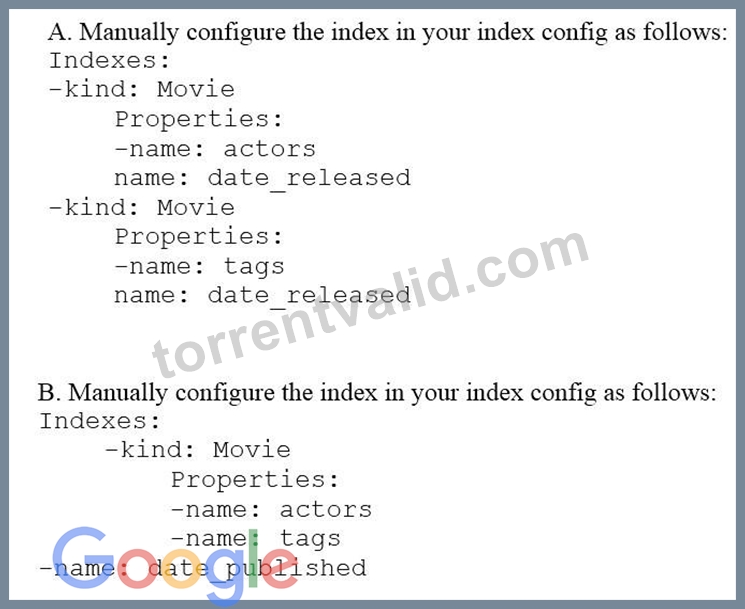

- A. Option C
- B. Option A
- C. Option B.
- D. Option D
Answer: B
NEW QUESTION # 110
You are designing a basket abandonment system for an ecommerce company. The system will send a message to a user based on these rules:
No interaction by the user on the site for 1 hour
Has added more than $30 worth of products to the basket Has not completed a
transaction
You use Google Cloud Dataflow to process the data and decide if a message should be sent. How should you design the pipeline?
- A. Use a global window with a time based trigger with a delay of 60 minutes.
- B. Use a sliding time window with a duration of 60 minutes.
- C. Use a fixed-time window with a duration of 60 minutes.
- D. Use a session window with a gap time duration of 60 minutes.
Answer: A
NEW QUESTION # 111
You work for an advertising company, and you've developed a Spark ML model to predict click-through rates at advertisement blocks. You've been developing everything at your on-premises data center, and now your company is migrating to Google Cloud. Your data center will be closing soon, so a rapid lift-and- shift migration is necessary. However, the data you've been using will be migrated to migrated to BigQuery.
You periodically retrain your Spark ML models, so you need to migrate existing training pipelines to Google Cloud. What should you do?
- A. Rewrite your models on TensorFlow, and start using Cloud ML Engine
- B. Spin up a Spark cluster on Compute Engine, and train Spark ML models on the data exported from BigQuery
- C. Use Cloud Dataproc for training existing Spark ML models, but start reading data directly from BigQuery
- D. Use Cloud ML Engine for training existing Spark ML models
Answer: C
NEW QUESTION # 112
You operate a logistics company, and you want to improve event delivery reliability for vehicle-based sensors. You operate small data centers around the world to capture these events, but leased lines that provide connectivity from your event collection infrastructure to your event processing infrastructure are unreliable, with unpredictable latency. You want to address this issue in the most cost-effective way. What should you do?
- A. Establish a Cloud Interconnect between all remote data centers and Google.
- B. Have the data acquisition devices publish data to Cloud Pub/Sub.
- C. Write a Cloud Dataflow pipeline that aggregates all data in session windows.
- D. Deploy small Kafka clusters in your data centers to buffer events.
Answer: B
Explanation:
Pubsub is global service with high message delivery capacity.
NEW QUESTION # 113
You are building a model to make clothing recommendations. You know a user's fashion preference is
likely to change over time, so you build a data pipeline to stream new data back to the model as it
becomes available. How should you use this data to train the model?
- A. Train on the existing data while using the new data as your test set.
- B. Train on the new data while using the existing data as your test set.
- C. Continuously retrain the model on just the new data.
- D. Continuously retrain the model on a combination of existing data and the new data.
Answer: B
NEW QUESTION # 114
When a Cloud Bigtable node fails, ____ is lost.
- A. the time dimension
- B. all data
- C. the last transaction
- D. no data
Answer: D
Explanation:
A Cloud Bigtable table is sharded into blocks of contiguous rows, called tablets, to help balance the workload of queries. Tablets are stored on Colossus, Google's file system, in SSTable format. Each tablet is associated with a specific Cloud Bigtable node. Data is never stored in Cloud Bigtable nodes themselves; each node has pointers to a set of tablets that are stored on Colossus. As a result:
Rebalancing tablets from one node to another is very fast, because the actual data is not copied. Cloud Bigtable simply updates the pointers for each node. Recovery from the failure of a Cloud Bigtable node is very fast, because only metadata needs to be migrated to the replacement node.
When a Cloud Bigtable node fails, no data is lost
Reference: https://cloud.google.com/bigtable/docs/overview
NEW QUESTION # 115
Which SQL keyword can be used to reduce the number of columns processed by BigQuery?
- A. SELECT
- B. WHERE
- C. LIMIT
- D. BETWEEN
Answer: A
Explanation:
Explanation
SELECT allows you to query specific columns rather than the whole table.
LIMIT, BETWEEN, and WHERE clauses will not reduce the number of columns processed by BigQuery.
Reference:
https://cloud.google.com/bigquery/launch-checklist#architecture_design_and_development_checklist
NEW QUESTION # 116
What is the general recommendation when designing your row keys for a Cloud Bigtable schema?
- A. Include multiple time series values within the row key
- B. Keep your row key as long as the field permits
- C. Keep the row keep as an 8 bit integer
- D. Keep your row key reasonably short
Answer: D
Explanation:
A general guide is to, keep your row keys reasonably short. Long row keys take up additional memory and storage and increase the time it takes to get responses from the Cloud Bigtable server. Reference: https:// cloud.google.com/bigtable/docs/schema-design#row-keys
NEW QUESTION # 117
You want to build a managed Hadoop system as your data lake. The data transformation process is composed of a series of Hadoop jobs executed in sequence. To accomplish the design of separating storage from compute, you decided to use the Cloud Storage connector to store all input data, output data, and intermediary dat
a. However, you noticed that one Hadoop job runs very slowly with Cloud Dataproc, when compared with the on-premises bare-metal Hadoop environment (8-core nodes with 100-GB RAM). Analysis shows that this particular Hadoop job is disk I/O intensive. You want to resolve the issue. What should you do?
- A. Allocate additional network interface card (NIC), and configure link aggregation in the operating system to use the combined throughput when working with Cloud Storage
- B. Allocate more CPU cores of the virtual machine instances of the Hadoop cluster so that the networking bandwidth for each instance can scale up
- C. Allocate sufficient persistent disk space to the Hadoop cluster, and store the intermediate data of that particular Hadoop job on native HDFS
- D. Allocate sufficient memory to the Hadoop cluster, so that the intermediary data of that particular Hadoop job can be held in memory
Answer: D
NEW QUESTION # 118
Which SQL keyword can be used to reduce the number of columns processed by BigQuery?
- A. SELECT
- B. WHERE
- C. LIMIT
- D. BETWEEN
Answer: A
Explanation:
SELECT allows you to query specific columns rather than the whole table.
LIMIT, BETWEEN, and WHERE clauses will not reduce the number of columns processed by
BigQuery.
NEW QUESTION # 119
Cloud Bigtable is a recommended option for storing very large amounts of
____________________________?
- A. multi-keyed data with very high latency
- B. single-keyed data with very high latency
- C. single-keyed data with very low latency
- D. multi-keyed data with very low latency
Answer: C
Explanation:
Cloud Bigtable is a sparsely populated table that can scale to billions of rows and thousands of columns, allowing you to store terabytes or even petabytes of data. A single value in each row is indexed; this value is known as the row key. Cloud Bigtable is ideal for storing very large amounts of single-keyed data with very low latency. It supports high read and write throughput at low latency, and it is an ideal data source for MapReduce operations.
Reference: https://cloud.google.com/bigtable/docs/overview
NEW QUESTION # 120
Which of the following statements about Legacy SQL and Standard SQL is not true?
- A. You need to set a query language for each dataset and the default is Standard SQL.
- B. Standard SQL is the preferred query language for BigQuery.
- C. One difference between the two query languages is how you specify fully-qualified table names (i.e.
table names that include their associated project name). - D. If you write a query in Legacy SQL, it might generate an error if you try to run it with Standard SQL.
Answer: A
Explanation:
Explanation
You do not set a query language for each dataset. It is set each time you run a query and the default query language is Legacy SQL.
Standard SQL has been the preferred query language since BigQuery 2.0 was released.
In legacy SQL, to query a table with a project-qualified name, you use a colon, :, as a separator. In standard SQL, you use a period, ., instead.
Due to the differences in syntax between the two query languages (such as with project-qualified table names), if you write a query in Legacy SQL, it might generate an error if you try to run it with Standard SQL.
Reference:
https://cloud.google.com/bigquery/docs/reference/standard-sql/migrating-from-legacy-sql
NEW QUESTION # 121
Your company is streaming real-time sensor data from their factory floor into Bigtable and they have noticed extremely poor performance. How should the row key be redesigned to improve Bigtable performance on queries that populate real-time dashboards?
- A. Use a row key of the form <sensorid>.
- B. Use a row key of the form <timestamp>#<sensorid>.
- C. Use a row key of the form <timestamp>.
- D. Use a row key of the form >#<sensorid>#<timestamp>.
Answer: D
NEW QUESTION # 122
You have spent a few days loading data from comma-separated values (CSV) files into the Google BigQuery table CLICK_STREAM. The column DT stores the epoch time of click events. For convenience, you chose a simple schema where every field is treated as the STRING type. Now, you want to compute web session durations of users who visit your site, and you want to change its data type to the TIMESTAMP. You want to minimize the migration effort without making future queries computationally expensive. What should you do?
- A. Add a column TS of the TIMESTAMP type to the table CLICK_STREAM, and populate the numeric values from the column TS for each row. the column TS instead of the column DT from now on.
- B. Delete the table CLICK_STREAM, and then re-create it such that the column DT is of the TIMESTAMP type. Reload the data.
- C. Add two columns to the table CLICK STREAM: TS of the TIMESTAMP type and IS_NEW of the BOOLEAN type. Reload all data in append mode. For each appended row, set the value of IS_NEW to true. For future queries, the column TS instead of the column DT, with the WHERE clause ensuring that the value of IS_NEW must be true.
- D. Construct a query to return every row of the table CLICK_STREAM, while using the built-in function to cast strings from the column DT into TIMESTAMP values. Run the query into a destination table NEW_CLICK_STREAM, in which the column TS is the TIMESTAMP type. the table NEW_CLICK_STREAM instead of the table CLICK_STREAM from now on. In the future, new data is loaded into the table NEW_CLICK_STREAM.
- E. Create a view CLICK_STREAM_V, where strings from the column DT are cast into TIMESTAMP values. the view CLICK_STREAM_V instead of the table CLICK_STREAM from now on.
Answer: C
NEW QUESTION # 123
You are a retailer that wants to integrate your online sales capabilities with different in-home assistants, such as Google Home. You need to interpret customer voice commands and issue an order to the backend systems.
Which solutions should you choose?
- A. Dialogflow Enterprise Edition
- B. Cloud Speech-to-Text API
- C. Cloud Natural Language API
- D. Cloud AutoML Natural Language
Answer: D
NEW QUESTION # 124
Which of these operations can you perform from the BigQuery Web UI?
- A. Upload a 20 MB file.
- B. Load data with nested and repeated fields.
- C. Upload multiple files using a wildcard.
- D. Upload a file in SQL format.
Answer: B
Explanation:
Explanation
You can load data with nested and repeated fields using the Web UI.
You cannot use the Web UI to:
- Upload a file greater than 10 MB in size
- Upload multiple files at the same time
- Upload a file in SQL format
All three of the above operations can be performed using the "bq" command.
Reference: https://cloud.google.com/bigquery/loading-data
NEW QUESTION # 125
Your company's on-premises Apache Hadoop servers are approaching end-of-life, and IT has decided to migrate the cluster to Google Cloud Dataproc. A like-for-like migration of the cluster would require 50 TB of Google Persistent Disk per node. The CIO is concerned about the cost of using that much block storage.
You want to minimize the storage cost of the migration. What should you do?
- A. Tune the Cloud Dataproc cluster so that there is just enough disk for all data.
- B. Put the data into Google Cloud Storage.
- C. Migrate some of the cold data into Google Cloud Storage, and keep only the hot data in Persistent Disk.
- D. Use preemptible virtual machines (VMs) for the Cloud Dataproc cluster.
Answer: D
Explanation:
Explanation/Reference:
Reference: https://cloud.google.com/dataproc/
NEW QUESTION # 126
Your organization has been collecting and analyzing data in Google BigQuery for 6 months. The majority
of the data analyzed is placed in a time-partitioned table named events_partitioned. To reduce the
cost of queries, your organization created a view called events, which queries only the last 14 days of
data. The view is described in legacy SQL. Next month, existing applications will be connecting to
BigQuery to read the eventsdata via an ODBC connection. You need to ensure the applications can
connect. Which two actions should you take? (Choose two.)
- A. Create a new view over events using standard SQL
- B. Create a new partitioned table using a standard SQL query
- C. Create a service account for the ODBC connection to use for authentication
- D. Create a Google Cloud Identity and Access Management (Cloud IAM) role for the ODBC connection
and shared "events" - E. Create a new view over events_partitioned using standard SQL
Answer: A,D
NEW QUESTION # 127
You need to store and analyze social media postings in Google BigQuery at a rate of 10,000 messages per minute in near real-time. Initially, design the application to use streaming inserts for individual postings.
Your application also performs data aggregations right after the streaming inserts. You discover that the queries after streaming inserts do not exhibit strong consistency, and reports from the queries might miss in-flight dat
- A. Re-write the application to load accumulated data every 2 minutes.
- B. Convert the streaming insert code to batch load for individual messages.
- C. Estimate the average latency for data availability after streaming inserts, and always run queries after waiting twice as long.
- D. Load the original message to Google Cloud SQL, and export the table every hour to BigQuery via streaming inserts.
- E. How can you adjust your application design?
Answer: E
NEW QUESTION # 128
......
Professional-Data-Engineer certification guide Q&A from Training Expert TorrentValid: https://passleader.torrentvalid.com/Professional-Data-Engineer-valid-braindumps-torrent.html