


Pass Snowflake GES-C01 Exam With Practice Test Questions Dumps Bundle
2026 Valid GES-C01 test answers & Snowflake Exam PDF
NEW QUESTION # 31
A company is building a chatbot for internal support, powered by Snowflake Cortex LLMs. The primary goals are to provide answers that are accurate, grounded in proprietary documentation, and to minimize factual 'hallucinations'. They are considering various strategies to achieve this. Which of the following statements correctly describe effective methods or tools within Snowflake for addressing these concerns?
- A. Deploying a custom fine-tuned model using SNOWFLAKE.CORTEX.FINETUNE on proprietary documentation is the most effective approach to ensure factual accuracy for any LLM task.
- B. Enabling Cortex Guard with guardrails: true directly addresses model hallucinations by ensuring responses are always factually correct and aligned with the provided context.
- C. Using Cortex Search as a Retrieval Augmented Generation (RAG) engine can enhance LLM responses by providing relevant context from proprietary documentation, thereby reducing hallucinations.
- D. For tasks requiring LLMs to generate SQL queries from natural language, using the Cortex Analyst verified Query Repository (VQR) can improve accuracy by leveraging pre-verified SQL queries for similar questions.
- E. AI Observability can be leveraged to systematically evaluate applications, measuring metrics like 'factual correctness and 'groundedness' to detect and mitigate hallucinations, especially in summarization.
Answer: C,D,E
Explanation:
Option B is correct: Cortex Search is explicitly designed as a RAG engine to enhance LLM responses with contextualized information from Snowflake data, which directly addresses factual accuracy and reduces hallucinations. Option C is correct: AI Observability's evaluation features, including 'factual correctness and 'groundednes' scores, are specifically mentioned for detecting the truthfulness and relevance of responses based on retrieved context, and for avoiding LLMs with high hallucination frequencies, especially in summarization tasks. Option D is correct: The Cortex Analyst Verified Query Repository (VQR) provides a collection of pre-verified SQL queries for specific natural language questions, significantly improving the accuracy and trustworthiness of SQL generation and reducing errors that could be seen as 'hallucinations' in the text-to-SQL context. Option A is incorrect: While fine-tuning (using 'SNOWFLAKE.CORTEX.FINETUNE) can adapt a model to specific tasks and data, it is not a direct guarantee against 'all' factual inaccuracies or 'hallucinations' for 'any' LLM task, especially if the fine- tuning data itself is limited or the model generalizes poorly. RAG is generally preferred for grounding responses in up-to-date external knowledge. Option E is incorrect: Cortex Guard is designed to filter 'harmful or unsafe' LLM responses, not to directly ensure factual correctness or prevent hallucinations related to content accuracy or grounding.
NEW QUESTION # 32
A company is using Snowflake AI Observability to evaluate a summarization application. The application utilizes SNOWFLAKE. CORTEX. COMPLETE for LLM inference and a custom Python component for text pre-processing. The team is particularly interested in tracking detailed cost breakdowns and assessing the factual correctness of the LLM-generated summaries. Which of the following statements accurately describe the cost implications and evaluation metric capabilities in this scenario?
- A. AI Observability incurs charges for the LLM judges invoked via COMPLETE (SNOWFLAKE .CORTEX) calls to compute evaluation metrics, in addition to warehouse charges for managing runs and queries.
- B. The ORTEX_DOCUMENT_PROCESSING_USAGE_HISTORY view is the primary tool to monitor the credit consumption specifically for AI Observability evaluations and LLM judge usage.
- C. For evaluating summarization tasks, the 'context relevance' score is the most important metric, as it directly assesses the quality of the LLM's output against the source document.
- D. To measure the factual correctness of LLM-generated summaries based on original input and avoid hallucinations, the 'factual correctness' and 'comprehensiveness' metrics can be used during evaluations.
- E. The cost of AI Observability is primarily determined by the number of messages processed, and the number of tokens in each message does not affect the cost, ensuring predictable pricing.
Answer: A,D
Explanation:
NEW QUESTION # 33
A financial institution needs to process thousands of incoming PDF loan application forms daily, extracting applicant names, loan amounts, and submission dates, and loading them into a Snowflake table. They aim for continuous processing with minimal manual intervention. Which of the following statements correctly describe how Document AI can be used in an automated SQL pipeline for this purpose?
- A. To ensure continuous data ingestion and processing, a STREAM can be created on the stage to detect new PDF documents, triggering the TASK for extraction and subsequent loading into a Snowflake table.
- B. The extracted information, including confidence scores and values, is returned as a JSON object, which can then be parsed into separate columns in a Snowflake table using SQL functions like LATERAL FLATTEN.
- C. Document AI's PREDICT method natively supports all PDF files up to 500 MB and 500 pages, allowing for large-scale, single-query processing without requiring users to split documents into smaller chunks.
- D. The SNOWFLAKE .DOCUMENT_INTELLIGENCE_CREATOR database role alone is sufficient for defining the model build and configuring the processing pipeline, without needing additional CREATE MODEL privileges on the schema.
- E. The pipeline can leverage the <model build name> ! PREDICT method within a CREATE TASK statement to automatically process new PDFs as they arrive in an internal or external stage, once the Document AI model build is published.
Answer: A,B,E
Explanation:
Option A is correct because DocumentAI supports creating automated pipelines with tasks that call the method to extract information from documents in a stage. Option B is correct as streams are used to detect new data (e.g., PDFs) in a stage, and tasks can be set up to execute when new data is available in the stream, enabling continuous processing. Option E is correct because the 'PREDICT method returns its results as a JSON object, which typically contains 'score' and 'value' fields for extracted entities, and this JSON output can be parsed into separate columns using 'LATERAL FLATTEN'. Option C is incorrect as, in addition to the 'SNOWFLAKE.DOCUMENT_INTELLIGENCE_CREATOR database role, the role used must also have 'CREATE SNOWFLAKE.ML.DOCUMENT_INTELLIGENCE and 'CREATE MODEL' privileges on the schema where the model build is located. Option D is incorrect because DocumentAI has specific limitations on document size (max 50 MB) and page count (max 125 pages per document), and also limits processing to a maximum of 1000 documents in one query.
NEW QUESTION # 34
A new ML Engineer, 'data_scientist_role' , has been assigned to a project involving custom machine learning models in Snowflake. They need to gain the necessary permissions to perform the following actions related to Snowflake Model Registry and Snowpark Container Services: 1. Log a custom model into a specified schem a. 2. Deploy that model to an existing Snowpark Container Service compute pool. 3. Call the deployed model for inference using SQL. Which of the following SQL commands grant the 'minimal' required privileges to the for these actions, assuming the compute pool and image repository already exist and are appropriately configured?
- A.

- B.

- C.

- D.

- E.

Answer: B,C
Explanation:
Option A is correct because the 'CREATE MODEL' privilege on the target schema is required to log a new model (which creates a model object) in the Snowflake Model Registry. Option D is correct because deploying a model to a Snowpark Container Service creates a service object within a schema, which requires the 'CREATE SERVICE privilege on that schema. The role would also implicitly need 'USAGE on the specified compute pool. Option B is incorrect. While 'USAGE ON DATABASE is generally needed for accessing objects within a database, it's a broader prerequisite and not specifically a minimal privilege for the direct model registry actions of logging, deploying, and calling the model. Option C is incorrect because 'CREATE COMPUTE POOL' is for creating the compute pool itself, not for deploying a service 'to' an existing one. The role would need 'USAGE' on the existing compute pool, but not the right to create it from scratch for this scenario. Option E is incorrect because 'READ ON IMAGE REPOSITORY is required for the 'service' to pull the image from the repository, but the question asks for privileges for the to perform the 'actions' of logging, deploying, and calling. While the role might need to manage or verify the image, this isn't a direct privilege for the user's interaction with the deployed model in the same way 'CREATE MODEL' or 'CREATE SERVICE are.
NEW QUESTION # 35
A data science team is deploying a custom real-time inference service for a fine-tuned LLM using Snowpark Container Services (SPCS). They have a Docker image in their Snowflake image repository. They need to define the service using a YAML specification file. Which of the following are ''essential'' components or configurations that must be included in the 'spec.yaml'' file for a long- running service that uses this image, custom environment variables, and requires external access?
- A.

- B.

- C.

- D.

- E.
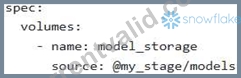
Answer: A,B,D
Explanation:
Option A is correct because the 'container' block, specifying the 'name' of the container and the Docker 'image' path from the Snowflake registry, is fundamental for defining any containerized service in SPCS. Option B is correct as the 'endpoints' block, explicitly defining a 'name', 'port' , and setting 'public: true' , is essential for a long-running service that requires external access via a web browser or API. Option C is incorrect because the 'compute_poor is specified during the 'CREATE SERVICE SQL command, not within the 'spec.yaml' file itself. Option D is incorrect as a 'volumes' block, while potentially useful for persistent storage, is not listed as an essential component in the provided spec.yaml' examples for basic service deployment. Option E is correct as the 'env' block within a container definition is used to set custom environment variables, which is explicitly shown in the Jupyterlab example for configuring the application within the container.
NEW QUESTION # 36
A Snowflake team observes consistently high token costs from 'SNOWFLAKE.ACCOUNT_USAGE.CORTEX_FUNCTIONS_QUERY_USAGE_HISTORY' for a summarization task using the 'mistral- large2' model. The task involves summarizing legal documents, which often exceed the context window of common LLMs. To optimize these token-based costs, which strategy should the team prioritize?
- A. Option E
- B. Option C
- C. Option A
- D. Option D
- E. Option B
Answer: B
Explanation:
Option C is correct. For summarization of lengthy documents, exceeding the context window or using large inputs significantly increases token consumption. Text splitting, for example using , can break documents into smaller, more manageable chunks. This reduces the number of input tokens per LLM call, directly leading to cost optimization, and is recommended for best search results and LLM response quality with Cortex Search. Option A is incorrect because for Cortex AISQL functions, Snowflake recommends using a smaller warehouse (no larger than MEDIUM) as larger warehouses do not increase performance but can result in unnecessary costs associated with keeping the warehouse active. The compute cost for Cortex LLM functions is based on tokens processed, not warehouse size performance. Option B is incorrect because 'TRY COMPLETE only prevents costs for 'failed' operations by returning NULL instead of an error. It does not optimize the token consumption of 'successful' summarization tasks. Option D is incorrect; Cortex Guard processes additional tokens for its filtering, thus 'increasing' token consumption, not reducing it. Option E is incorrect because setting 'temperature' to 0 makes the output more deterministic, which might improve consistency but does not directly reduce the number of input or output tokens processed for a summarization task.
NEW QUESTION # 37
A data engineering team is deploying Snowflake Cortex Analyst to enable natural language queries over their structured SALES_DATA table, which includes columns like PRODUCT_CATEGORY, SALES_AMOUNT, and ORDER_DATE. To maximize the accuracy and trustworthiness of responses for business users, which of the following practices should the team implement when configuring their semantic model?
- A. Option E
- B. Option C
- C. Option A
- D. Option D
- E. Option B
Answer: A,C
Explanation:
Option A is correct because semantic models are defined in YAML and uploaded to a stage. When using VQR, logical table names in the SQL field must be prefixed with two underscores (e.g., sales_data), and logical column names are used directly. Option B is incorrect because 'Explore options' is a component of Cortex Agents for planning and disambiguation, not a feature within Cortex Analyst's semantic model configuration. Cortex Analyst uses semantic models to bridge language gaps but does not have an explicit 'Explore options' feature in this context. Option C is incorrect because VQR SQL queries must use the *logical* table and column names defined in the semantic model, not the physical names of the underlying dataset directly. Option D is incorrect. While exists, its purpose is to present a full set of predefined questions for onboarding, not to force prioritization for *all* complex questions regardless of semantic similarity to the user's input. This could lead to incorrect answers if the question isn't truly an onboarding question. Option E is correct because Cortex Analyst can integrate with Cortex Search Service within dimension definitions of the semantic model to improve literal string searches, which helps in cases where literal values cannot be directly extracted from the question.
NEW QUESTION # 38 

- A. Option D
- B. Option E
- C. Option B
- D. Option A
- E. Option C
Answer: A,C
Explanation:
NEW QUESTION # 39
A data engineering team is designing a scalable data pipeline in Snowflake that involves processing large text inputs with Cortex AI LLM functions. They want to ensure cost efficiency and prevent queries from failing due to exceeding LLM context window limits. They plan to use SNOWFLAKE. CORTEX. COUNT_TOKENS for pre-validation. Which of the following statements are TRUE about the role and cost of COUNT_TOKENS in this scenario? (Select all that apply)
- A. Option E
- B. Option C
- C. Option A
- D. Option D
- E. Option B
Answer: A,B,C
Explanation:
Option A is correct. Embedding models like
have a fixed context window of 512 tokens. Using COUNT_TOKENS allows pre-checking if text fits within this limit, preventing truncation that can occur when the input exceeds the context window. Option B is incorrect because COUNT_TOKENS incurs only compute cost to run the function and does not incur additional token-based costs that would add to the billing of subsequent LLM inference calls. Option C is correct. For best search results, Snowflake recommends splitting text into chunks of no more than 512 tokens. This practice generally leads to higher retrieval and downstream LLM response quality in RAG scenarios, and COUNT_TOKENS is a valuable tool for managing these chunk sizes. Option D is incorrect. While COUNT_TOKENS incurs compute cost (not token-based cost), the amount of compute would generally scale with the size of the input text it processes, making the cost not entirely independent of input length, although it's not billed on a per-token basis for its own operation. Option E is correct. The COUNT_TOKENS function is available in all regions for any model, though the models themselves may have specific regional availabilities for other functions.
NEW QUESTION # 40
An organization enforces strict LLM access control. The has configured 'CORTEX MODELS_ALLOWLIST ='mistral-large2" and executed 'CALL SNOWFLAKE.MODELS.CORTEX BASE MODELS REFRESH()'. A developer, whose role DEV ROLE has been granted 'SNOWFLAKE.CORTEX USER' and 'SNOWFLAKE."CORTEX-MODEL-ROLE-CLAUDE-3-5- SONNET"' , attempts to make a REST API call to 'api/v2/cortex/inference:complete' using 'claude-3-5-sonnet' as the model name in the request body. Which of the following statements are true regarding this scenario?
- A. Option E
- B. Option C
- C. Option B
- D. Option A
- E. Option D
Answer: B,C
Explanation:
Option A is incorrect. When the model is specified as a plain string '"claude-3-5-sonnet"' in the REST API request, Cortex first attempts to match it as a schema-level model object by that plain name. If this fails (as is typical for built-in models which often use quoted identifiers like "'CLAUDE-3-5-SONNET"'), it then checks the plain name against the 'CORTEX_MODELS_ALLOWLIST. Since 'claude-3-5- sonnet' is not in the allowlist, the call will be denied despite the user's role having the application role for the model object 'SNOWFLAKE.MODELS."CLAUDE-3-5-SONNET"'. option B is correct because the parameter explicitly limits which models can be used by the 'Cortex LLM REST API'. Option C is correct. To use 'claude-3-5-sonnet' via the REST API, it either needs to be added to the account-level as a plain name, or the request must explicitly use the fully-qualified object identifier 'SNOWFLAKE.MODELS."CLAUDE-3-5-SONNET"' which would then be subject to RBAC on that model object. Option D is incorrect. An HTTP '403 Not Authorized' error typically indicates that the account is not enabled for the REST API or the calling user's default role lacks the 'SNOWFLAKE.CORTEX USER database role. For 'AI_COMPLETE (which 'COMPLETE' maps to), an error related to an unallowed model would contain information about how to modify the allowlist, implying a different error message than a generic '403'. Option E is incorrect. The 'ENABLE CORTEX ANALYST MODEL AZURE_OPENAF parameter is specifically for Cortex Analyst and determines if it can use Azure OpenAl models, but it is incompatible with model-level RBAC for Cortex Analyst. It does not affect generic 'COMPLETE (SNOWFLAKE.CORTEX)' REST API calls.
NEW QUESTION # 41
A data engineering team needs to configure their Snowflake environment to process documents using AI_PARSE_DOCUMENT and generate text embeddings using EMBED_TEXT_1024 with the voyage-multilingual-2 model. Their Snowflake account is in a region where these specific capabilities or models are only available via cross-region inference. The team needs to ensure these functions work correctly without constant region-specific model selection. Which of the following is the correct configuration action and an important consideration?
- A. Option E
- B. Option B
- C. Option A
- D. Option C
- E. Option D
Answer: A,B
Explanation:
NEW QUESTION # 42
A security architect is configuring access controls for a new custom role, 'document_processor_role' , which will manage Document AI operations within a designated database 'doc_processing_db' and schema 'doc_workflow_schema'. The goal is to grant only the minimum essential database-level role required to begin working with Document AI features.
- A.

- B.

- C.

- D.

- E.

Answer: B
Explanation:
To work with Document AI, the database role must be granted to the account role. This role specifically enables creating Document AI model builds and working on document processing pipelines. Option A grants a more general Cortex user role, which is not the specific foundational role for Document AI. Option B grants access to all Cortex models, but not the foundational Document AI database role itself. Options D and E grant schema-level or warehouse-level privileges, which are also necessary but are not the database-level 'role' specifically for DocumentAI capabilities.
NEW QUESTION # 43
A data scientist is leveraging various Snowflake Cortex LLM functions to process extensive text data for an application. To effectively manage their budget, they need a clear understanding of how costs are incurred for each specific function. Which of the following statements accurately describe how costs are calculated for Snowflake Cortex LLM functions, with a particular focus on token usage?
- A. Option D
- B. Option E
- C. Option B
- D. Option A
- E. Option C
Answer: A,C
Explanation:
Option B is correct because for the 'EXTRACT_ANSWER function, the number of billable tokens is the sum of the tokens in the Trom_text' (source_document) and 'question' fields. Option D is correct as for 'CLASSIFY TEXT (or labels, descriptions, and examples provided in the categories are counted as input tokens for each record processed, which directly increases the cost. Option A is incorrect because 'EMBED TEXT 768' and 'EMBED TEXT 1024' functions only count 'input tokens' towards the billable total, not both input and output tokens. Option C is incorrect because Cortex Structured Outputs does not incur additional compute cost for the overhead of verifying tokens against the supplied JSON schema, although schema complexity can increase total token consumption. Option E is incorrect because (and 'SNOWFLAKE.CORTEX.PARSE_DOCUMENT) billing is based on the 'number of document pages processed' (e.g., 3.33 Credits per 1 ,000 pages for Layout mode), not just the number of documents. For paged formats (PDF, DOCX), each page is billed as a page; for image files, each image is a page; for HTML/TXT, each 3,000 characters is a page.
NEW QUESTION # 44
A Snowflake user attempts to access the Cortex Playground to experiment with LLM functions but receives an error indicating insufficient privileges. They have an active Snowflake session. Which of the following steps must be taken to ensure they can successfully use the Cortex Playground?
- A. Option D
- B. Option E
- C. Option C
- D. Option A
- E. Option B
Answer: A,D
Explanation:
NEW QUESTION # 45
A data engineering team is building an automated pipeline within Snowflake to process newly ingested documents. This pipeline needs to classify each document's sentiment (positive, neutral, negative) and summarise its content using Cortex LLM functions, then store the results in a table. The pipeline is orchestrated using Streams and Tasks. Which considerations are paramount for implementing and monitoring this AI-infused data pipeline?
- A. Option E
- B. Option C
- C. Option B
- D. Option A
- E. Option D
Answer: B,C,D
Explanation:
NEW QUESTION # 46
A team is planning the implementation of a new Document AI solution and needs to be aware of the specific guidelines and limitations concerning naming conventions and task management within Snowflake. A primary concern is to avoid common pitfalls that could lead to errors or unsupported configurations.
- A. While optional, creating a separate database and schema specifically for Document AI assets is a best practice for organization and cost visibility.
- B. Document AI supports concurrent user activity on the same model build in Snowsight, enabling multiple team members to upload documents and review answers simultaneously.
- C. Document AI model builds can be renamed after their initial creation and publication to align with evolving project naming standards.
- D. For optimal cost management and to avoid resource contention, Document AI tasks should leverage serverless task configurations.
- E. Database and schema identifiers referenced in Document AI operations must not include double quotes, as this is an unsupported syntax.
Answer: A,E
Explanation:
Option A is incorrect because DocumentAI does not currently support renaming models. Option B is incorrect as Document AI does not support serverless tasks. Option C is correct as Document AI does not support double quotes around identifiers for the database and schema. Option D is correct as Snowflake recommends creating a separate database and schema for Document AI to help track costs and manage objects. Option E is incorrect because Document AI does not support multiple users working on the same model build at the same time in Snowsight.
NEW QUESTION # 47
A company wants to ingest and process scanned invoices and digitally-born contracts in Snowflake. They need to extract all text, preserving layout for contracts and just the text content for scanned invoices. Which AI_PARSE_DOCUMENT modes would be most appropriate for this scenario, and what is the primary purpose of the function itself?
- A. Primary purpose is to generate new text. For contracts, use OCR mode; for invoices, use LAYOUT mode.
- B. Primary purpose is to summarize text. For contracts, use OCR mode; for invoices, use LAYOUT mode.
- C. Primary purpose is to extract data and layout. For contracts, use LAYOUT mode; for invoices, use OCR mode.
- D. Primary purpose is to translate text. Both document types should use LAYOUT mode.
- E. Primary purpose is to classify text. For contracts, use LAYOUT mode; for invoices, use OCR mode.
Answer: C
Explanation:
Option C is correct. AI_PARSE_DOCUMENT is a Cortex AI SQL function designed to extract text, data, and layout elements from documents with high fidelity, preserving structure like tables, headers, and reading order. For digitally-born contracts where layout preservation is needed, the mode is appropriate. For scanned invoices where only text content is needed without layout, the OCR mode, which extracts text LAYOUT from scanned documents and does not preserve layout, is suitable.
NEW QUESTION # 48
A new Gen AI team member attempts to use Document AI to process a batch of 1 ,500 scanned image files (JPG) that are 70 MB each, stored in an internal stage that was created without specifying an encryption type. Their '!PREDICT' queries consistently fail with various errors. Which of the following are valid reasons for the '!PREDICT' queries to fail in this scenario?
- A. The internal stage was not created with 'ENCRYPTION = (TYPE = 'SNOWFLAKE SSE'V, which is a requirement for Document AI.
- B. The individual JPG files exceed the maximum supported file size for Document AI.
- C. Processing 1 ,500 documents in one query exceeds the maximum limit for Document AI.
- D. The team member's role lacks the database role, which is essential for using Document AI functions.
- E. JPG is an unsupported file format for Document AI.
Answer: A,B,C,D
Explanation:
Option A is correct because internal stages used with Document AI must specify 'ENCRYPTION = (TYPE = 'SNOWFLAKE_SSE')' when created. Option B is correct as the database role is required for the account role to use Document AI functions to extract information. Option C is correct because Document AI supports processing a maximum of 1 ,000 documents in one query, so 1 ,500 documents would exceed this limit. Option D is correct because documents processed by Document AI must be 50 MB or less in size, and the 70 MB files exceed this limit. Option E is incorrect because JPG is listed as a supported file format for Document AI.
NEW QUESTION # 49
A data engineering team is setting up an automated pipeline to extract information from new invoices using Document AI. They've created a database and schema Cinvoice_db.invoice_schema') and a Document AI model build ('invoice_extractor'). They then created an internal stage for documents. When they attempt to run the 'invoice_extractor!PREDlCT' method on documents uploaded to 'invoice_stage' , they consistently receive the following error:
Given this error message, which 'corrective SQL command' addresses the most likely misconfiguration of the 'invoice_stage' to allow Document AI processing?
- A.

- B.

- C.

- D.

- E.

Answer: E
Explanation: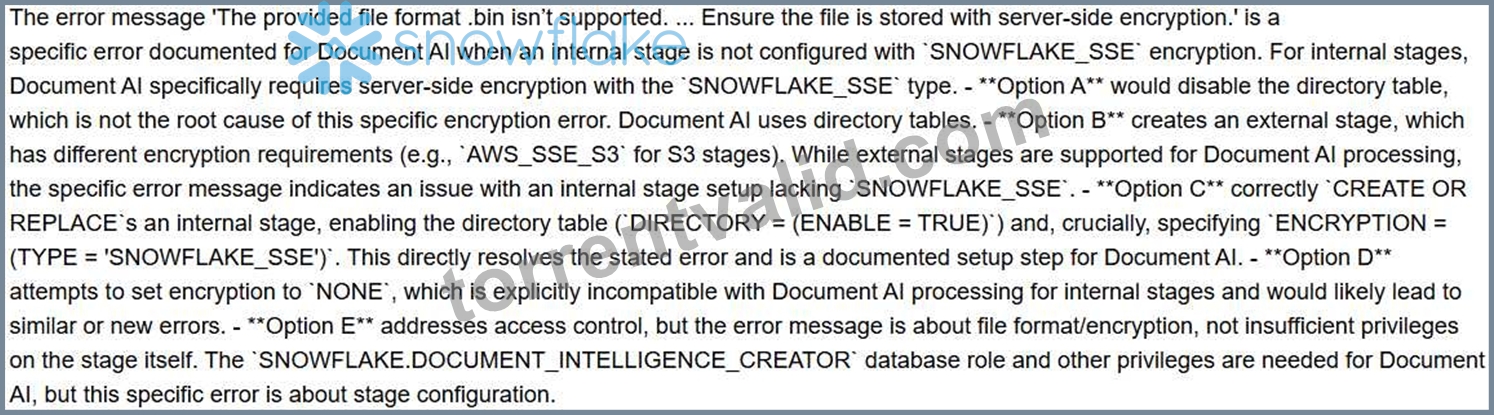
NEW QUESTION # 50
A data scientist is optimising a Cortex Analyst application to improve the accuracy of literal searches within user queries, especially for high-cardinality dimension values. They decide to integrate Cortex Search for this purpose. Which of the following statements are true about this integration and the underlying data types in Snowflake? (Select all that apply)
- A. Cortex Search Services, when configured as a source for Snowflake dynamic tables, automatically refresh their search index with continuous data updates, maintaining low-latency search results.
- B. For optimal RAG retrieval performance with Cortex Search, it is generally recommended to split text into chunks of no more than 512 tokens, even when using embedding models with larger context windows such as 'snowflake-arctic-embed-l-v2.0-8k'.
- C. The cost for embedding data into a Cortex Search Service is primarily incurred per output token generated by the embedding model, as these represent the final vector embeddings, rather than input tokens.
- D. The "VECTOR data type in Snowflake, used to store embeddings generated for Cortex Search, is fully supported as a clustering key in standard tables and as a primary key in hybrid tables to accelerate vector similarity searches.
- E. To integrate Cortex Search with a logical dimension, the semantic model YAML must include a block within the dimension's definition, specifying the service name and optionally a 'literal_column' .
Answer: B,E
Explanation:
Option A is correct. Cortex Analyst can leverage Cortex Search Services to improve literal search by including a configuration block within a dimension's definition in the semantic model YAML. This block specifies the service name and an optional 'literal_column'. Option B is correct. Snowflake recommends splitting text in your search column into chunks of no more than 512 tokens for best search results with Cortex Search, even when using models with larger context windows like 'snowflake-arctic-embed-l-v2.0-8k' This practice typically leads to higher retrieval and downstream LLM response quality in RAG scenarios. Option C is incorrect. The 'VECTOR data type is allowed in hybrid tables but is explicitly not supported as a primary key, secondary index key, or clustering key in Snowflake. Option D is incorrect. For EMBED_TEXT functions, which are used to generate embeddings for Cortex Search, only 'input tokens' are counted towards the billable total, not output tokens. The Cortex Search service itself is billed per GBImonth of indexed data. Option E is incorrect. Snowflake Cortex functions, including Cortex Search, do not support dynamic tables.
NEW QUESTION # 51
A project team is preparing to deploy a Document AI solution to process scanned customer feedback forms. They have created a dedicated role, 'customer feedback _ processor', and successfully granted it the SNOWFLAKE. DOCUMENT_INTELLIGENCE_CREATOR database role. The environment consists of 'feedback database, 'forms schema' schema, and 'ai workload warehouse. However, when the attempts to prepare a Document AI model build in Snowsight, they encounter a 'permission denied' error. Which of the following missing 'USAGE' grants could be the direct cause of this error?
- A.

- B.

- C.

- D.

- E.

Answer: B,C,E
Explanation:
NEW QUESTION # 52
A developer is building a conversational application using Snowflake Cortex Analyst and is interacting with it via the REST API. The application needs to support multi-turn conversations where users can ask follow-up questions. Which of the following statements accurately describe how to maintain conversational state and interact with the Cortex Analyst REST API for a multi-turn experience?
- A. The argument, when using the 'COMPLETE function (or its API equivalent), must be a string for single-turn conversations but an array of objects for multi-turn conversations, with each object containing 'role' and 'content'.
- B. The Cortex Analyst REST API automatically retains the full conversation history for each user session, eliminating the need to explicitly pass previous messages.
- C. To maintain state, the application must construct a 'messages' array for each new prompt, including all prior 'user' prompts and 'analyst' responses in chronological order, and send it with every API call.
- D. A special 'RESET_CONVERSATION' API endpoint should be called periodically to clear the LLM's internal context and manage token consumption for long conversations.
- E. For performance optimization, only the most recent user prompt and the immediate preceding analyst response should be passed in the 'messages' array for follow-up questions.
Answer: A,C
Explanation:
Option B is correct. Cortex Analyst (and the underlying COMPLETE function) does not retain state from one call to the next. To provide a stateful conversational experience, the application must explicitly pass all previous user prompts and model (analyst) responses in the conversation as part of the 'messages' (or array for each new request. Option C is also correct. The argument for the 'COMPLETE function (and its REST API equivalent) accepts a string for single-turn prompts, but an array of objects for multi- turn conversations, where each object has a 'role' (e.g., 'user', 'assistant', 'system') and 'content'. Option A is incorrect because Cortex Analyst functions do not retain state; the conversation history must be explicitly managed by the client application. Option D is incorrect; while sources suggest resetting a long conversation if interpretation struggles, there is no command mentioned for cost optimization or clearing internal LLM context. Cost is managed by token usage, which increases with conversation length. Option E is incorrect. To maintain full conversational context, previous user prompts and model responses should be passed, not just the most recent ones. Passing only a partial history would lead to loss of context.
NEW QUESTION # 53 
- A. The 'ACCOUNTADMIN' must execute the SQL command:

- B. Users with 'ds_team_role' will still be able to successfully call

- C. Enabling Cortex Guard for 'AI_COMPLETE through the 'guardrails' option automatically bypasses the 'CORTEX_MODELS_ALLOWLIST to ensure all LLMs can be used for content safety filtering.
- D. The parameter provides granular control at the database or schema level, allowing administrators to define different sets of approved models for different data contexts.
- E. If a user attempts to call an LLM not explicitly listed in the via the Cortex LLM Playground, Snowflake will automatically fall back to the 'snowflake-arctic' model for that request.
Answer: A,B
Explanation: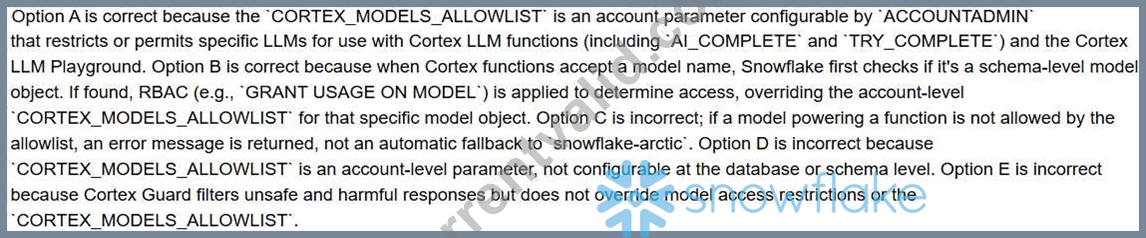
NEW QUESTION # 54
......
Top Snowflake GES-C01 Courses Online: https://passleader.torrentvalid.com/GES-C01-valid-braindumps-torrent.html